As we covered in the previous article, by March 2026, Fox ESS was installed by 29% of active battery installers. The two brands it was chasing were installed by 39 to 45%. Yet Fox ESS became the largest brand for H1-2026 according to SunWiz data.
You cannot do that on reach alone. The answer is Installer Depth: when an installer used Fox ESS, how much of their battery work did Fox ESS get?
What depth measures
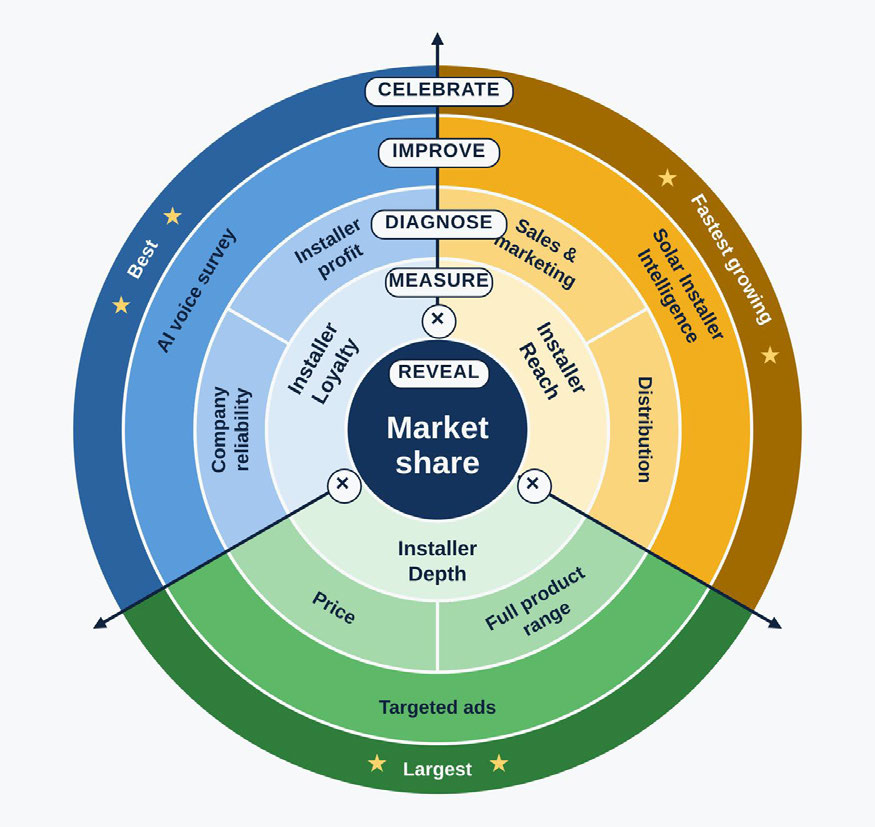
Installer Depth is a brand’s share of an installer’s battery portfolio, among the installers who use it. High reach with low depth means installers know you but treat you as a backup. High depth means you are their default. Depth is driven by three levers: product range, segment coverage and price.
Climbing from 2% to 37% of its installers’ portfolios
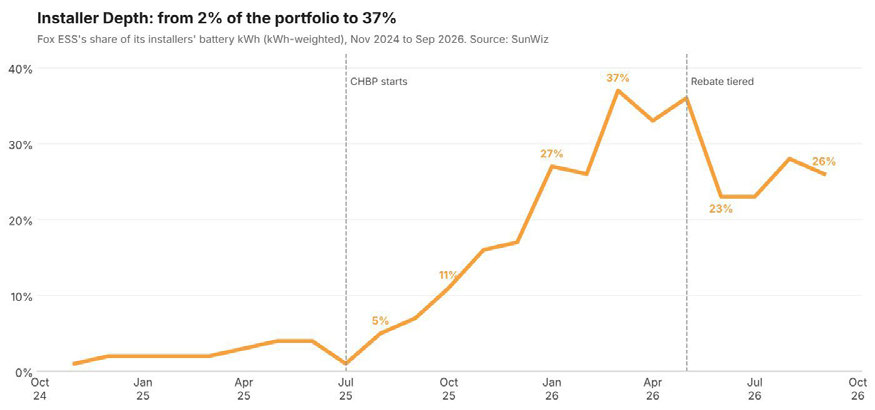
Through the first half of 2025, Fox ESS held 2 to 4% of its installers’ battery kWh. The climb began in August 2025 and did not peak until March:
| Month | Fox ESS installer depth |
|---|
| August 2025 | 5% |
| October 2025 | 11% |
| December 2025 | 17% |
| January 2026 | 27% |
| March 2026 | 37% |
At 37%, Fox ESS held the highest installer depth of any battery brand in Australia. From March to May 2026, an installer who used Fox ESS put more than a third of their battery kWh into it, more than the installers of either larger-reach brand put into theirs.
That is why reach of 29% of installers was enough to lead the market. Fox ESS had fewer installers, but each of them bought more.
Product-market fit: the key influence on Installer Depth
System size was a key factor that accompanied Fox ESS’s installer depth. Australia’s battery market changed shape in the lead-up to the rebate and through its first year. Fox ESS had a product built for exactly that shape: a large, modular battery that, with the economies of scale behind it and the way it was priced, was close to ideal for an Australian household sizing up under the Cheaper Home Batteries Program.
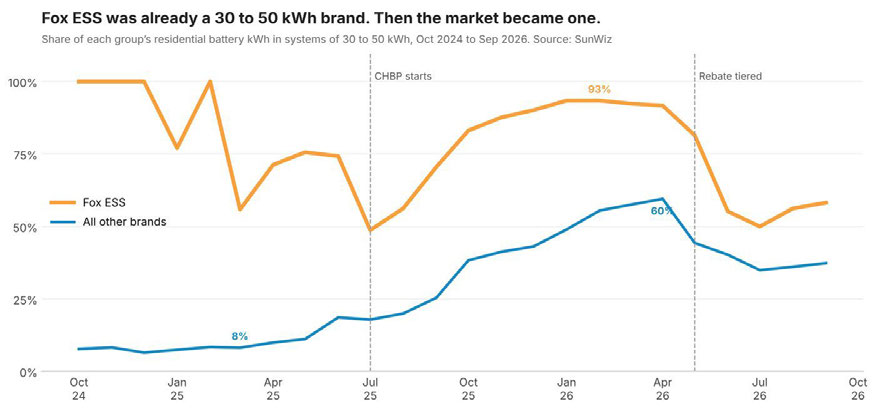
At the start of 2025, systems of 30 to 50 kWh made up about 8% of all other brands’ residential battery kWh. Fox ESS already had most of its kWh in that bracket. As the Cheaper Home Batteries Program took hold, the rest of the market followed: 25% of kWh in that bracket by September 2025, 43% by December, 57% by March 2026 and 60% in April.
Fox ESS did not move. Through the surge it had 83 to 93% of its kWh in 30 to 50 kWh systems. The market grew into the size Fox ESS was already built for.
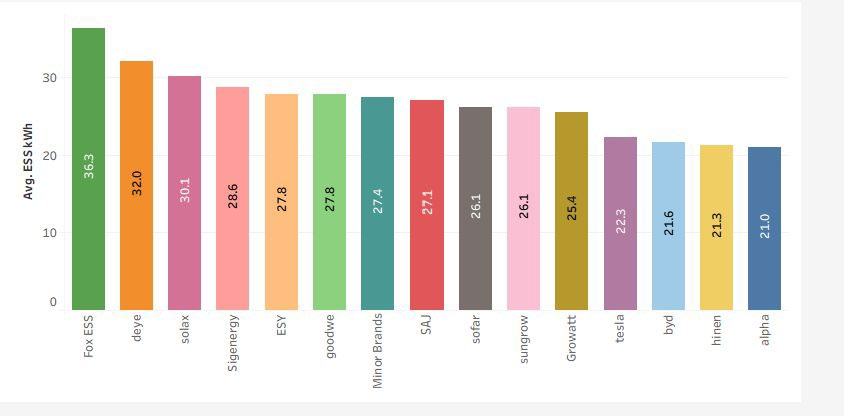
The effect on the numbers is direct. Over the past twelve months Fox ESS’s average system has been 36 kWh, the largest of any brand and about a third above the market. Its share of systems installed over the past year is about 12 to 14%. Its share of kWh is 18 to 20%. A 42 kWh system is a big slice of any installer’s month, which is what a depth figure of 37% looks like in practice.
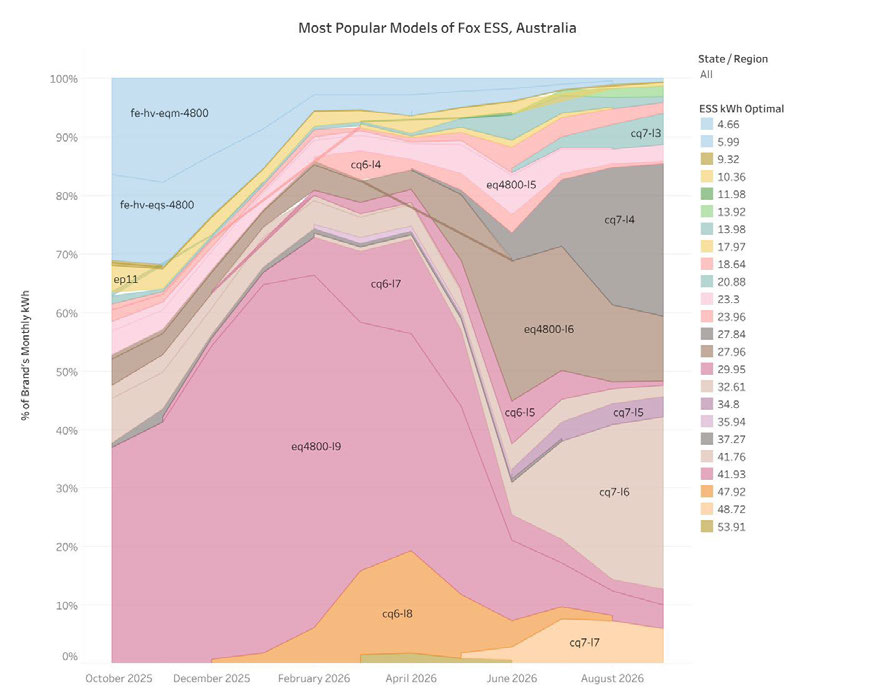
One product carried most of it. A single 42 kWh configuration made up 37% of Fox ESS’s kWh in October 2025 and 63% in January 2026. Fox ESS then launched a second generation in the same size class from February, which was a third of its kWh by April. Range renewal while scaling is a depth lever in its own right.
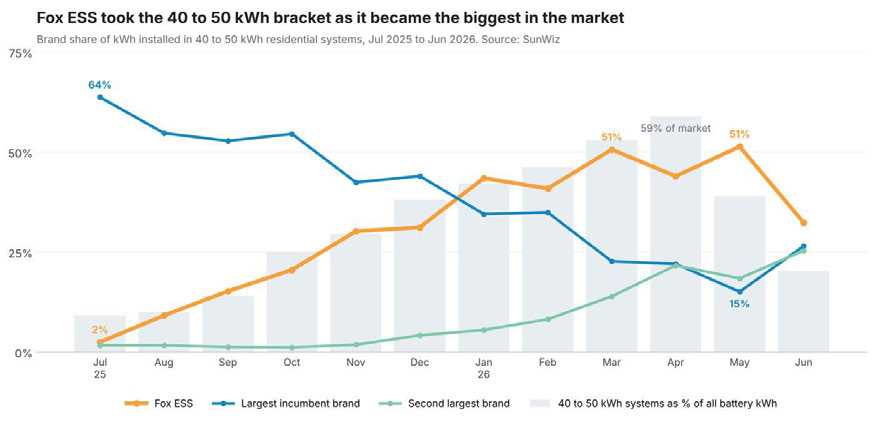
The result was a changing of the guard in the bracket that mattered most. In July 2025, the largest incumbent brand held 64% of kWh installed in 40 to 50 kWh systems and Fox ESS held 2%. By March 2026 Fox ESS held 51% and the incumbent 23%. Over the same months, that bracket grew from 9% of all residential battery kWh to 59%.
Fox ESS did not win a little of everything. It won most of the one bracket that became the biggest in the market.
Price: Installer Depth’s second influence
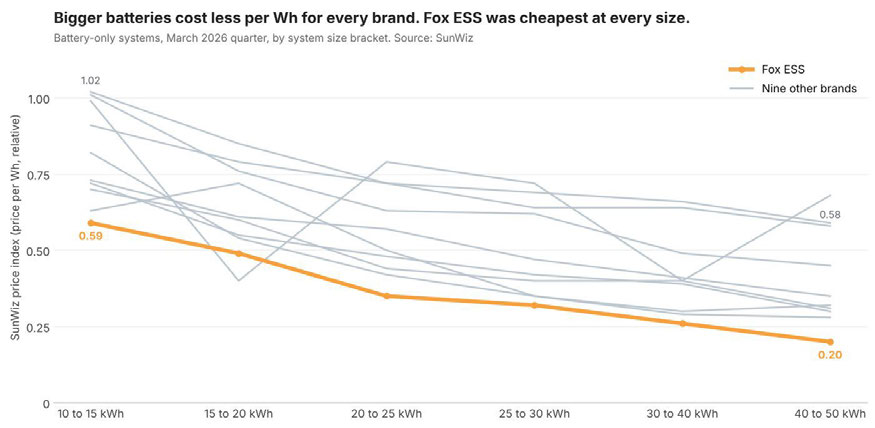
The second lever that drives Installer Depth is price. The lower the price, the greater the likelihood an installer will use it for more of their portfolio. In Fox ESS’s case, price clearly unlocked Installer Depth, due to economies of scale. Across every brand, the price per watt-hour of a 40 to 50 kWh battery is about half that of a 10 to 15 kWh battery. The rebate made large systems affordable, and large systems are the cheapest systems per unit of storage. Fox ESS, selling almost nothing but large systems, had scale on its side before any brand-level pricing came into it.
The second level is brand pricing within a size bracket, and here Fox ESS was still the sharpest. On SunWiz’s consumer-price index (i.e. installed, after subsidy prices) for 40 to 50 kWh battery-only systems in the March 2026 quarter, Fox ESS sat at about two-thirds of the index of the next cheapest major brands and about a third of the index of the two largest brands. Several brands were in the same territory as Fox ESS on price. None of them came close on share.
An installer quoting a 40 kWh system had a price reason to lead with Fox ESS, and the depth figures say they did. Price alone does not explain it, though: Fox ESS wasn’t the only brand offering low prices. Fox ESS was a low-priced brand that could point to being ranked by SunWiz as number one for volume in both the UK and Germany.
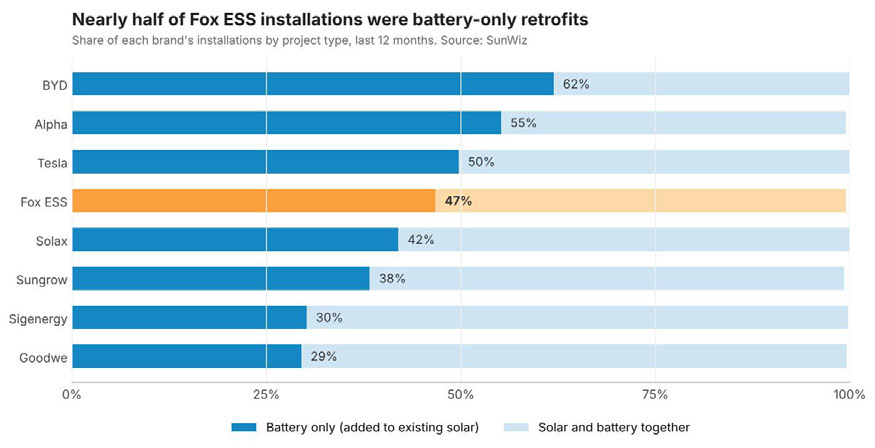
The third lever, segment coverage, is where Fox ESS was concentrated rather than broad. It is overwhelmingly a residential brand, with a strong position in sub-100 kW commercial and almost none above that. Through this period that focus was a strength: residential is where the rebate volume was. Within residential, Fox ESS also served both halves of the market. About 47% of its installations over the past year were battery-only, added to an existing solar system, against roughly 30% for the two largest brands. Fox ESS was a retrofit brand and a new-build brand at the same time, which is one more reason installers reached for it across more of their jobs.
What the rebate change tested
When the rebate was tiered by size on 1 May 2026, the obvious question was whether a brand built on 40 kWh systems had the wrong product for the new rules. The market reshaped: total volumes fell, and the 30 to 50 kWh share of other brands’ kWh dropped from 60% in April to 35% by July.
The concern has not held up. Fox ESS’s depth dipped to 23% in June and was back to 26 to 28% by August and September. More importantly, the size brackets where Fox ESS has a natural advantage are growing again. Monthly kWh in 40 to 50 kWh systems more than tripled between May and September 2026, and 30 to 40 kWh systems roughly doubled. Those two brackets were 45% of residential battery kWh in September 2026, up from 30% in May. The market is sizing back up, and Fox ESS is already there.
Improve: the levers behind depth
Depth is where product and pricing strategy show up in the data. SunWiz provides tools for each lever:
- Comparative pricing assessment shows where your price sits against competitors in each size bracket and project type, and where a discount is winning share rather than giving away margin.
- Product portfolio gap assessment identifies the system sizes and segments where your installers buy from someone else. Each gap is depth you are leaving on the table.
- Product range benchmarking in the Brand Assessor tracks how much of the market your range can serve and how that compares to the leaders.
- AI-driven voice installer survey asks installers why they split their portfolio between brands, in their own words.
See your own depth
The Brand Assessor tracks Installer Depth monthly, by installer size, alongside your product range, popular models and comparative pricing. It shows whether a share movement is about winning installers or winning their work, and which product or price lever to pull.
Book a Brand Assessor walkthrough to see your brand’s depth.
Next in the series: Installer Loyalty, and why Fox ESS proposals closed more often than anyone else’s.