

Four weeks ago I told a room of Australian clients that Ireland’s battery growth was probably coming bigger batteries. I have since gone through the installer-level data properly. I was looking in the wrong place.
In summary
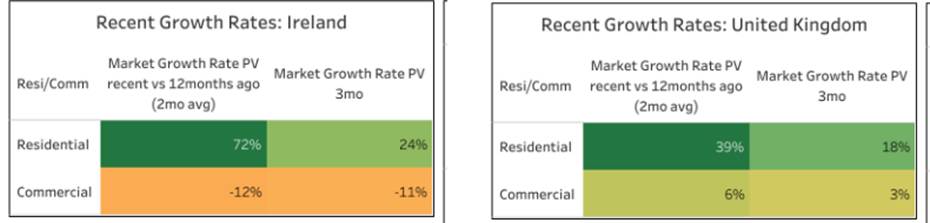
- Irish residential PV volumes are running 72% ahead of a year ago on a two-month average, against 39% in the UK, while Irish commercial volumes have gone backwards.
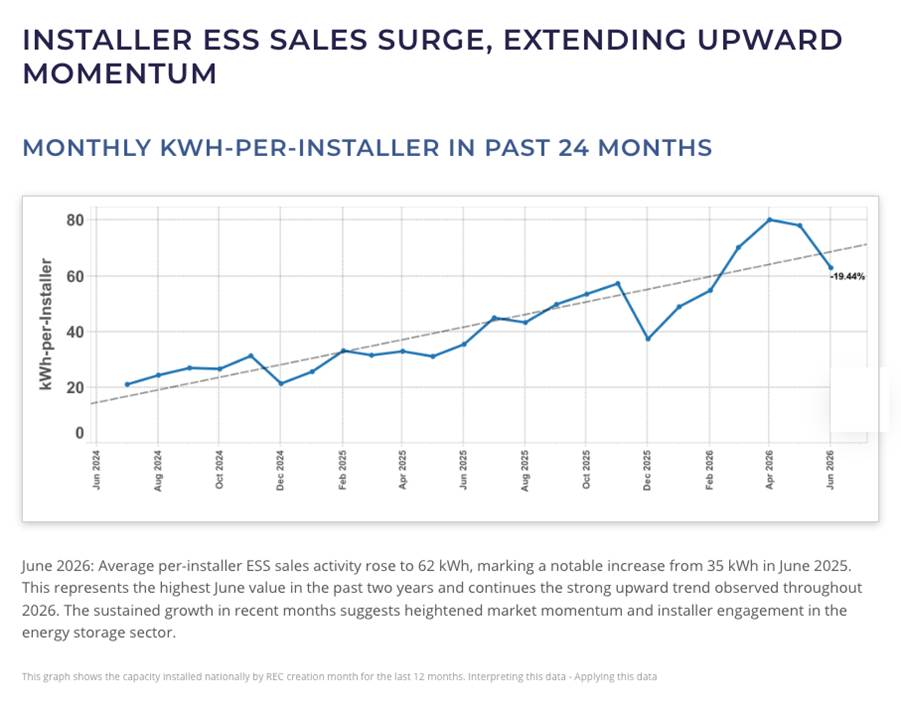
- I had assumed bigger batteries were doing the work. The installer-level data points elsewhere: average storage sold per installer rose from 35 kWh in June 2025 to 62 kWh in June 2026.
- Ireland’s growth is concentrating inside existing installer businesses rather than spreading thinly across new ones, which changes where a brand should be spending its effort.
Four weeks ago I told a room of Australian clients that Ireland’s battery growth was probably coming from bigger batteries. I have since gone through the installer-level numbers properly, and I was looking in the wrong place.
Start with the size of the thing, because Ireland is not a rounding error on the UK. Irish residential solar volumes are running 72% ahead of where they sat twelve months ago on a two-month average, and 24% ahead across three months. The equivalent UK figures are 39% and 18%. Irish commercial volumes, by contrast, have gone backwards on both measures, which makes this a residential story rather than a national one.
The question I had been turning over was which lever was doing the work. Irish households were either attaching batteries to their solar more often than before, or attaching larger ones, and my money was on size. The data offers a third answer, and a considerably more useful one, because it sits at the level where a brand can actually do something about it.
Average storage sold per installer in Ireland reached 62 kWh in June, up from 35 kWh in the same month a year earlier. April was starker still, at roughly 80 kWh per installer against 33 kWh in April 2025 and 21 kWh in April 2024. Systems per installer moved the same way over that April comparison, close to doubling from around 16 to 31. Whatever else is happening in Ireland, the individual installer businesses selling storage are selling a great deal more of it than they were a year ago.
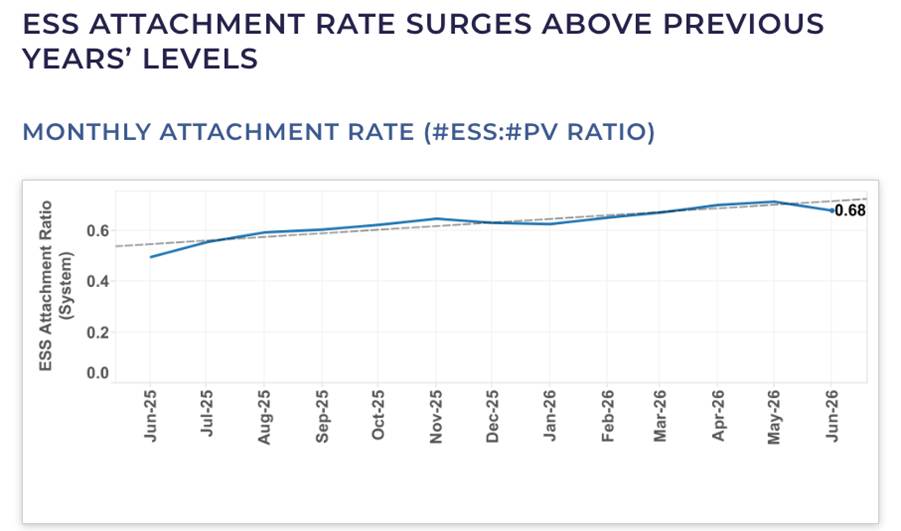
The attachment rate has climbed as well, and it deserves its share of the credit. It reached 0.68 in June after four consecutive months of growth, a little below May’s 0.71 peak and comfortably above where it sat through late 2025. More Irish solar systems are being paired with storage than at any point in the series, which is exactly the maturing behaviour you would hope to see.
Battery size, my original suspect, turns out to be the quietest of the three. The median Irish system has been holding steady rather than climbing, with the movement showing up at the upper end as larger systems gain share of a market whose middle remains firmly mid-sized. Enough to matter, and nowhere near enough to explain a market moving at this rate.
Put the three together and Ireland looks less like a market being lifted by a change in consumer taste and more like one being lifted by the people doing the selling. That distinction matters commercially. If growth were spreading evenly across a widening base of installers, the sensible response would be reach, getting your product into as many hands as possible. When the growth is concentrating inside individual installer businesses instead, depth is the lever that pays, and the brands that win will be the ones already sitting inside those businesses when the volume arrives.
June did carry two softer readings, and I would rather raise them than have someone else do it. The attachment rate slipped from May’s peak, and PV productivity fell 24% to 59 kW per installer after May’s 77 kW. Read in isolation, those look like a market topping out. I would be careful with that conclusion, because single months move for all sorts of reasons, June has form for seasonal softness in this market, and the twenty-four month trend line underneath both series has not bent. One month is a data point rather than a direction.
So if you sell storage into Ireland, the question worth asking is not whether the market is growing, because it plainly is. It is whether your product is sitting inside the installer businesses where that growth is concentrating, and whether you could tell the difference between an installer whose volume is climbing and one who is merely still on your list. That answer lives in installation-level data, updated monthly, which is what our Luminate platform exists to provide across Ireland, the UK, South Africa and Australia.
FAQs
On the most recent SunWiz figures, Irish residential PV volumes are 72% ahead of a year ago against 39% in the UK. The growth is concentrated in the residential segment, with Irish commercial volumes falling over the same period.
Chiefly the intensity of installer activity. Average storage sold per installer roughly doubled year on year, reaching 62 kWh in June 2026 against 35 kWh in June 2025, with attachment rates rising alongside it.
It reached 0.68 in June after four consecutive months of growth, slightly below May’s peak of 0.71, and remains well above the levels seen through late 2025 and early 2026.
Median system size has held broadly steady, with larger systems gaining share at the upper end of the market. Size is a contributor to growth rather than its main engine.
Single months move for many reasons, and June has a history of seasonal softness. The 24-month trend across both installer productivity and attachment rate remains upward.
Glossary
The ratio of battery storage systems to solar PV systems installed. A measure of how often solar is paired with storage.
The average storage capacity sold by each active installer in a period. A measure of installer-level intensity rather than market size.
The number of installers who install a given brand at all.
The share of an individual installer’s volume held by a given brand.
Installations at homes versus at businesses. In Ireland these are currently moving in opposite directions.
SunWiz’s market intelligence platform, delivering monthly installation-level data across Ireland, the UK, South Africa and Australia.