

The most popular commercial solar system in Australia is one almost nobody actually wanted. For fifteen years, businesses with the roof space and the power bills to justify 250, 400, even 800 kilowatts have installed 99 instead. And they were right to.
A single line in the Renewable Energy Target made undersizing rational. Systems under 100 kilowatts earn their subsidy upfront, a deemed lump of Small-scale Technology Certificates paid at installation. Above it, the system falls into the large-scale scheme: certificates earned slowly, year by year, with registration, paperwork and exposure to a moving certificate price. So a business with a 250 kilowatt roof could build 250 and wear all that, or build 99.9 and bank the money. Thousands chose 99.9.
That line is finally moving. The recent announcement that STC eligibility will extend to systems up to 1 megawatt from 1 October 2026 is the most consequential change to commercial solar policy in more than a decade. I have argued for it for years, because the 100 kilowatt cap was never about anything real on a rooftop. It was an administrative convenience, and the market contorted itself around it.
You can see the contortion in one chart. Sized from 30 kilowatts to 5 megawatts, the market should taper as systems get larger: big loads and big roofs are rarer than small ones. Instead it shows a wall and a cliff. The 90 to 100 kilowatt band, a sliver just ten kilowatts wide, has for years been the market’s single largest segment. At its peak it carried roughly as much annual capacity as every segment from 100 kilowatts to 1 megawatt combined. Healthy markets do not produce that spike. Loopholes do.
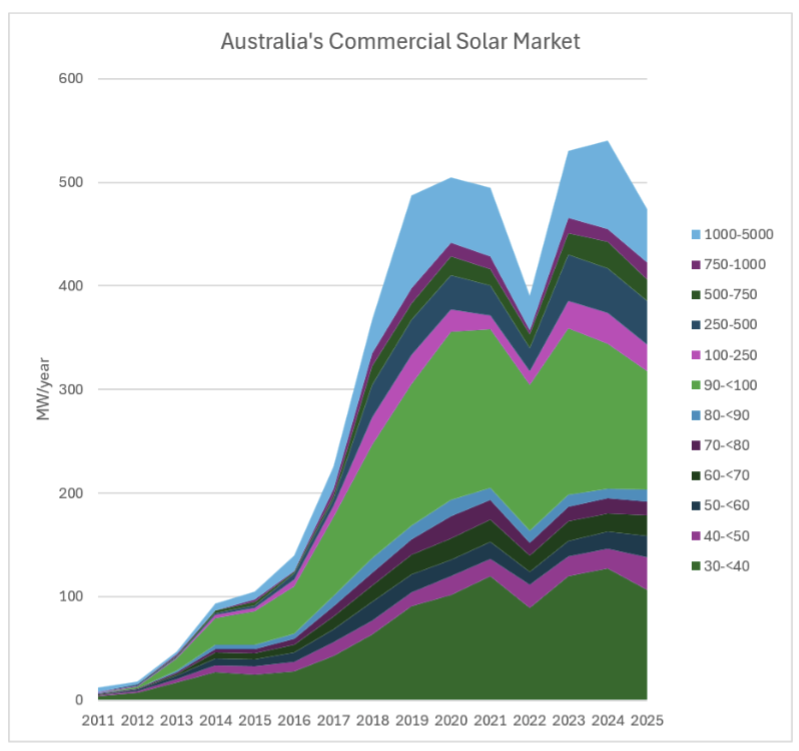
The result is a hole where the middle of the market should be. The bands from 100 kilowatts to 1 megawatt have spent years stuck in the low hundreds of megawatts of deployment, in a country whose commercial and industrial roofs could host tens of gigawatts. Residential solar has passed 22 gigawatts. The whole business sector sits at around a quarter of that, most below 100 kilowatts. In most other countries, commercial solar is the backbone of the industry, often outweighing both households and utility-scale. Australia inverted that: world-beating panels on homes, a strong utility pipeline, and a commercial middle that never grew up.
And lately it has gone backwards. The commercial market roughly doubled between 2016 and 2020, then stalled. It fell through 2021 and 2022, edged to a marginally higher peak in 2024, and shrank again in 2025. Several of the very bands this policy targets have shrunk, not grown. A market that flatlines while power prices climb, decarbonisation targets harden and roof space sits empty is not short of demand. It has a structural problem, and the 100 kilowatt line was most of it.
The fair objection is that the cap was never the only barrier, and it wasn’t. Mid-scale solar is harder than a home install: split incentives between landlords and tenants, capital competing with the core business, slow and inconsistent network connections. None of it vanishes on 1 October. But none of it explains a ten kilowatt sliver swallowing the market. Much of the missing middle was simply demand that wanted to be mid-scale, squeezed into the sub-100 kilowatt bucket. Remove the squeeze and it springs back. The government is moving on the other half of the bottleneck too, directing the AEMC to speed network approvals.
From October, a mid-scale system will earn the same upfront, deemed certificates a small one does today, cutting a project’s upfront cost by around a fifth on the government’s numbers. The first effect will not be new customers but right-sizing: the 99 kilowatt spike deflates and projects are finally built to the size their sites support. Capacity should rise before a single new business enters the market.
But thresholds do not disappear. They move. The behaviour that produced the 99 kilowatt system will now produce the 999 kilowatt one, clustering beneath the new ceiling. That is a far better problem: a 1 megawatt line constrains far fewer sites than a 100 kilowatt one. The distortion shrinks. It does not leave.
Whether Australia captures the opportunity rests with two groups. Regulators need to write the detail with the obvious first movers in mind: the thousands of sites already carrying a 100 kilowatt system sized by policy, not need. If an upgrade there can create certificates on the added capacity, a decade of pent-up demand is released. If the rules make it awkward, it isn’t. And the industry must turn back toward a market it let wither: a year on the residential battery boom left the skills mid-scale demands (engineering-led design, network negotiation, commercial finance) to atrophy. Those skills will not rebuild themselves. The businesses will be ready before the industry serving them is.
For fifteen years, the size of an Australian solar system was set by a line in a scheme. From October, it can be set by the roof. The chart is about to change shape, and this time the shape might finally tell the truth about the market.
Warwick Johnston is Managing Director of SunWiz, whose Luminate platform tracks the Australian solar and storage market. Data: SunWiz analysis of registered PV systems, 30 kilowatts to 5 megawatts.