
In summary
- Home battery markets move through five recognisable stages: emergence, acceleration, the norm, the turn and retrofit. National capacity totals hide which stage a country is in.
- Spain is emerging, Ireland is accelerating with no battery subsidy at all, and the UK has reached the point where storage is standard fit and competition shifts to specification and cost.
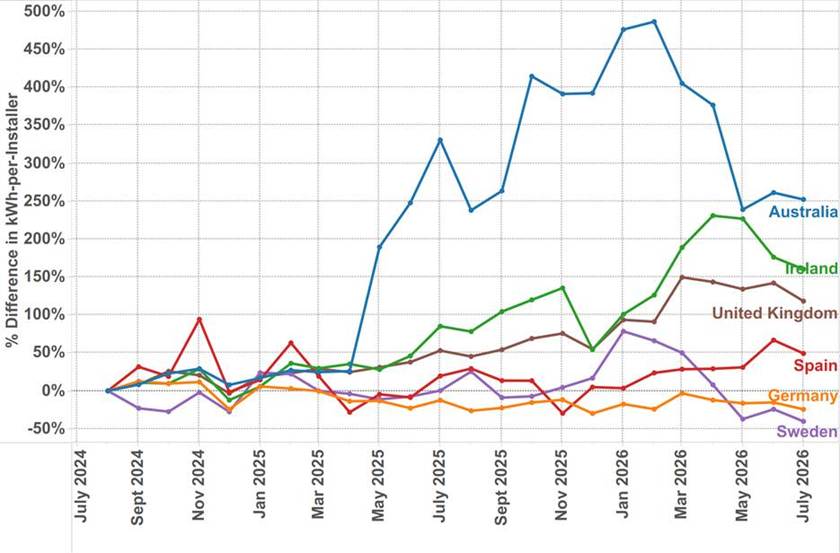
- Germany and Sweden have turned: residential demand is softening even as headline capacity climbs, and both now install less battery energy per installer than in mid-2024.
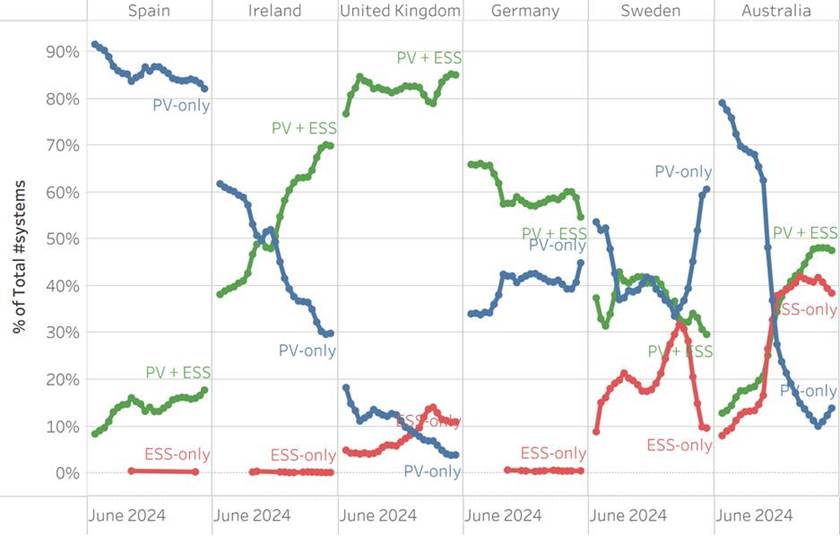
- Retrofit is a separate market triggered by collapsing export value. Australia’s attachment ratio has reached about 1.4, while Germany’s guaranteed feed-in tariffs keep standalone batteries below 1%.
- The right commercial move differs by stage, so decisions need like-for-like installation data measured the same way every month, rather than last quarter’s grid-connection totals.
Germany has more home batteries installed than any other country in Europe, yet its residential installers are handling less battery work each month. Those two facts only look contradictory if you size a market by volume, because Germany’s household segment has peaked and its capital, installers and margin are rotating to grid-scale storage. Every home battery market moves through a recognisable sequence of stages, and misreading which one a country has reached is an expensive mistake for anyone allocating stock, hiring salespeople or sizing an investment.
National capacity totals make the headlines, and they are the figures most likely to mislead. Two countries can post near-identical volume while sitting in completely different situations, one still building awareness from a standing start, the other nearing the point where almost every new system includes a battery. SunWiz Luminate tracks verified installation activity across six markets using the same method every month, and illustrate how market resolve into five stages.
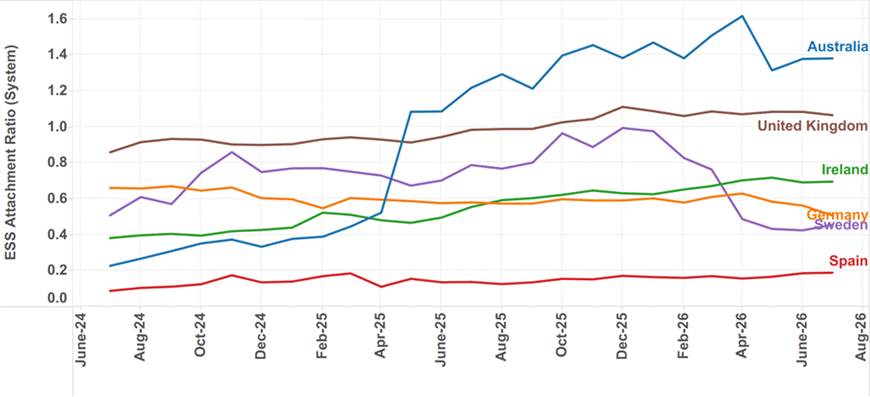
At the emergence stage, storage is a niche add-on only a minority request. Spain sits here, its attachment ratio having roughly tripled in two years but from a very low base, with more than four in five systems still solar-only because cheap daytime solar long made storage optional. Acceleration is the point where those economics tip and installers begin quoting storage by default, and Ireland is the clearest European example, with the share of systems including a battery climbing from under 40% to roughly 70% in two years. It managed that with no battery grant at all: the state subsidises the panels and pointedly excludes the battery. A wide gap between evening grid prices and export earnings makes the battery pay for itself, which is why Ireland is the best test of whether storage survives without a subsidy: it never had one.
Storage becomes standard fit at the next stage, when the commercial question shifts from whether a customer adds a battery to how large it should be. The United Kingdom has reached it, and in the retrofit and owner-commissioned market SunWiz observes, solar-only installations have fallen to a small single-digit share while attachment sits just above 1.0. Britain effectively runs two battery markets, a consumer market where storage is now assumed and a developer-led new-build market where it largely is not, and the second is almost wholly untapped. Once storage is assumed, competition shifts from persuasion to capacity, software and cost.
The turn arrives when residential demand softens and capital rotates towards grid scale even as national capacity keeps setting records, and two markets reached it by opposite routes. Germany graduated, its residential segment maturing and slowing while utility-scale storage surged, and steep price falls mean even flat volumes now yield falling revenue per installation; battery energy installed per installer has slipped below its mid-2024 level, the only market in the group where that holds on a sustained basis. Sweden went into reverse instead, its attachment ratio climbing to about 1.0 by late 2025 before halving within months. The cause was economics rather than policy: the grid-balancing revenue that made Swedish batteries pay was competed away as the market saturated, just as the export credit for microproduction was removed.
Retrofit is less a later stage than a second market that opens alongside the first, and it opens for one reason: exported electricity stops paying its way. While export earns close to retail value a retrofit undermines its own case, since it would store power the home is already paid to export; once that value collapses, every existing solar roof becomes a customer overnight. Australia shows this at full stretch, with battery-only retrofits climbing from under 10% of the market to around 40% and an attachment ratio near 1.4, the highest in the group, after feed-in tariffs collapsed and a federal rebate landed on a fleet with no export value left to defend. Germany is the mirror image: guaranteed feed-in tariffs still pay millions of systems well for their exports, so standalone batteries sit below 1% and have barely moved in two years. The same technology and the same maturity produce opposite outcomes because the export economics differ.
The obvious objection is that headline capacity growth is a good enough guide, and for a utility analyst it often is. For anyone selling into the residential channel it is close to useless, because a country can report record storage volumewhile its installers grow quieter, or post modest national numbers while nearly every new system quietly gains a battery. The right commercial move differs at each stage, from building awareness in emergence to winning installer loyalty in acceleration to selling, in a retrofit market, to someone who bought their solar from a competitor years ago.
Telling these situations apart means measuring what is installed, where and by whom, the same way in every market and every month, rather than reading last quarter’s grid-connection totals. Warwick Johnston will make that case for the UK market at Solar & Storage Live UK in Birmingham, including why the official figures understate its strength and which brands are leading it.
Warwick Johnston is Managing Director of SunWiz, whose Luminate platform tracks solar and storage installation activity across international markets.
About the data
These figures come from SunWiz Luminate’s verified sample of installation activity, drawn from hundreds of installers in each market and refreshed monthly. It is a sample rather than a census, and coverage varies by country: balcony solar is not captured in Germany, new-build housing solar is not captured in the United Kingdom, and comparable gaps exist elsewhere. Where a solar-heavy segment sits outside the sample, solar is undercounted and attachment is correspondingly overstated for that market. The data is built for comparison, setting countries against each other on a like-for-like basis and tracking the direction and pace of change, so it is best read as trends and gaps between markets rather than as an absolute count for any single figure.