
Clearing House News
The Clearing House is approaching the point of shifting in Q1, and could likely Clear in Q2
- Currently there are 5,604 STCs Registered and Pending Transfer and there are also an additional 362k in the clearing house, plus 555k Pending registered
- The quarterly surrender tally is 7,198k (35% of the 20,567k annual tally), meaning we are presently 677k short. Assume that on April 28 the same amount are pending registration (555k), making us 1232k short.
- Last week’s creation rate was 335k = 47.8k / day
- There are 42 days left of STC registration prior to the April 28 surrender date meaning 2007k STCs are likely to be created if current creation rates continue. We assume that the number Pending Registration remains as it is (555k) – those Pending Registration on the 28th April will not be available for surrender.
- This means we are likely to be ~775k in excess at the end of Q1. As the Clearing House presently has 362k in it, then we will be 413k above what we need without requiring the Clearing House.
- In 13 weeks time (Q2 surrender), certificate creation rates of 335k are required to avoid the Clearing House falling into deficit, and creation rates of 362k are required to avoid drawing upon the current Clearing House level. These assume 100% of the theoretical surrender occurs in Q1 and Q2
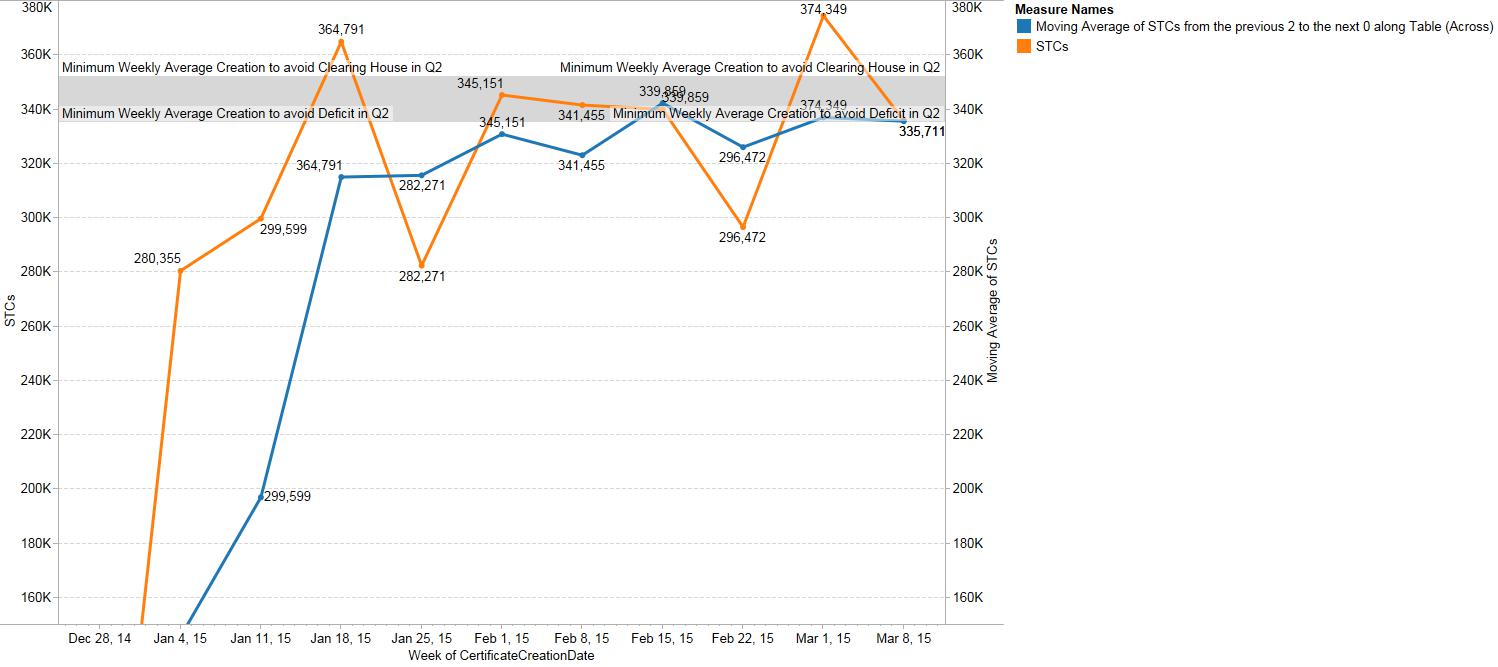
- The chart below shows the weekly STC creation in orange, and the rolling average of the past 3 weeks in blue. Indicated on the chart in grey are the lower levels required from here on in to avoid the Clearing House (upper line) and Deficit (lower line). Note that some percentage of recent week’s creation will ultimately end up Invalid due to Audit.
Other Exclusive STC news:
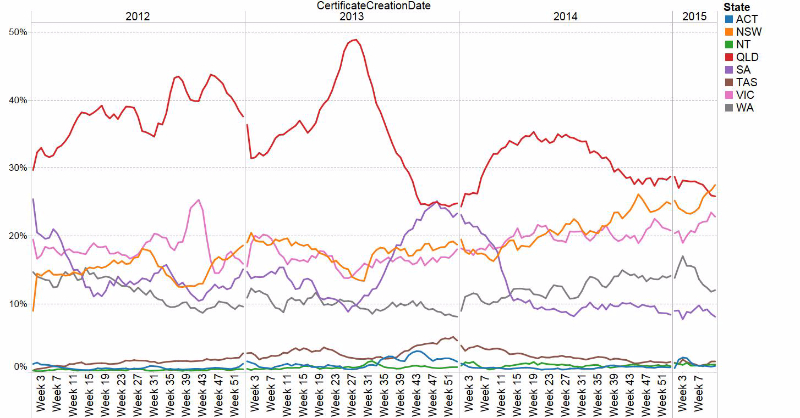
For the first time since 2011, Queensland has lost the “Sunshine State” badge. The graph above shows the proportion of national weekly STC creation by each state. Other than a brief moment when South Australia’s Feed-in Tariff closure sent STC creation skyrocketing, Queensland has dominated STC creation. However, since mid 2015 Queensland has been losing market share to New South Wales, with Victoria and Western Australia also picking up market share.
Average Service on Inverter Warranty
Its too early to say for certain, but both SMA and Fronius are providing the best warranty service in Australia. There are too few responses to single out any brand of inverter as providing poor service, but the clearly visible trend is for Chinese inverter manufacturers to provide poorer warranty service. This is concerning as preliminary responses also indicate that Chinese inverters are five times more likely to fail within 2 years when compared to non-Chinese inverters.
Note that there is insufficient responses thus far to form any conclusions. We’d love to hear your thoughts, particularly on Growatt, KLNE, Sungrow, Ginlong, and MacSolar.
Our Original request:
There’s been a heap of talk recently about poor quality panels and inverters. Without wanting to buy into any unwarranted political witch hunt, it has got me thinking: which solar panels and inverters are the most reliable, and which are the most problematic?
And hey, things go wrong with even the best equipment. In my mind, what makes a good product great is the knowledge that you’ll be looked after on the odd occasion that you need to make a warranty claim. So I’m interested in hearing of your experiences in making warranty claims for various panels and inverters/
The other thing of interest to me is how long it takes for problems to show up. The bathtub curve predicts that failures occur mostly in infant mortality and wear-out – so I’m interested to characterise whether it is too soon to witness end-of-life failures in Australian PV systems?
If you’d like to have your say in which are the most reliable (and the least reliable) PV panels and inverters, and which brands offer the best and worst warranty
3. There’s no margin for error (but this acts in your favour)
In residential PV, systems typically cost less than $10,000, so you’re not likely to face a massive legal bill if something goes wrong. In commercial PV, with $40k+ on the table, then there’s every chance you’ll be sued if you get something wrong. What goes wrong most often is an PV salesperson mis-reads a commercial electricity bill – these complex beasts involve a highly-confusing set of numbers and often a separate charge for peak demand. The most common bill misinterpretation errors are:
- Calculate a customers $/kWh figure by simply dividing the total bill by the total consumption – ignoring the standing charges and peak demand charges.
- Accounting for the peak demand charges but assuming that a 100kW PV system will reduce the demand charge by 100kW. There’s no guarantee that PV will reduce peak demand charges; PVsell’s often calculates a likely reduction of peak demand that equals 25% of the rated capacity of the PV system.
- Failing to consider that the value of solar generation is influenced by the peak, shoulder, off-peak, and export tariffs, and by the consumption profile.
The problem with all of this is that you can be sued for getting it wrong (and I’ve heard of a few cases where its happened). By promising to deliver a specified reduction in electricity bill, Australian Consumer Law implies that you need to make up the dollar difference if you fail to do so. Its a real pity that this occurs when there’s a sophisticatedly easy-to-use calculation tool that pays for itself in a single sale and which improves the professionalism of your proposal (so you can charge more). Anyway, a $40k system can’t be sold from calculations on back of a napkin.
The good thing about a lower margin for error is that your stupid competitors will inevitably get it wrong and suffer financially for it, not to mention incur major reputational damage. So its imperative to use an accurate financial calculator… and you can use the same tool to discover the maximum you can charge while still keeping your customer happy.
4. Its a numbers game, maximise your efficiently and efficacy.
A profitable commercial PV division is all about numbers. To justify the overhead of commercial salespeople, you need a large pipeline of potential customers, and an efficient process to focus upon the highest quality leads. Its best to start by filling the pipeline with high-quality leads, – the scattergun approach to customer acquisition was fine for residential, but commercial sales requires sniper-like precision.
Here’s the numbers for your business: reduce the cost of customer acquisition by effectively targeting the customers most likely to buy. Waste less time and effort selling to customers that lead nowhere. Improve your conversion rate by providing greater customer service and reducing your customer drop-off rate. Increase the price you can charge by demonstrating professional excellence and making the competition look risky. Put it together and you have lower operating cost, increased conversion rate, and increased profit margin, which together = super profits. Remember, its really important to fill your pipeline with high quality leads – from businesses most likely to buy PV.
Here’s a tantalising idea: if you get hold of one key number then you can have a very happy customer AND increase the price you charge (=pure profit). Getting hold of that one key number requires a small but significant change to your sales focus, and if you do this then you’ll be super-profitable and have a healthy referral business.
Part 2
In Part 2, we’ll reveal four more reasons and resources to tackle the commercial market profitably,
- The residential market is saturated; the commercial market is untapped
- You have the opportunity to define the terms of engagement
- Commercial is where all the profit is
- Get in on the Commercial Snowball – (“keeping up with the Jones Pty Ltd”)
We’ll also conclude with a neat summary you’ll want to print out.
ProfitVoltaics: Putting the Profit back into PV
ProfitVoltaics is based upon months of research into the Commercial PV market, identifying who the leaders are, what they do well, and how solar businesses can outperform the market.
ProfitVoltaics helps solar businesses to:
- Tackle the growing part of the industry: the commercial market
- Increase profits while improving the competitiveness of your offer
- Become the go-to business for solar in the best sectors and regions
- Ensure your marketing material and website aren’t turning customers away, wasting all your hard work
- Reach the decision maker and access customers sitting just beyond your reach
- Improve your conversion rate using SunWiz’s unique advantage
ProfitVoltaics includes these tools, tailored to your circumstances:
- The best places for your business to target for commercial sales in your service area
- The best businesses for your business to target, where you can harness your natural advantage and become the go-to guys
- A review of your sales material with recommendations for how to bring it up to best practise
- Psychological solar collateral that harnesses humans’ most powerful subconscious buying motivation
- A process and material to help you effortlessly educate your customer